
 Back to all updates
Published on11/24/2025
“Know Your Rights” Community Panel

[Note: This summary should not be considered as legal advice. If you are in need of legal assistance, please contact MIRC. If you attended the event and have feedback, please contact us.]
"It's not dangerous for people to know their rights. It's dangerous when they don't."
On November 16, the community gathered to discuss the current local policies and to seek advice on immigration rights through a “Know Your Rights” panel. The panel included Alyshia Dyer, Sheriff of Washtenaw County; Jack Kanarek, Staff Attorney from the Michigan Immigrant Rights Center (MIRC); Marlene Radzik, Saline’s Chief of Police; and the panel’s moderator, Nicole Rice. The panel was joined by about 40 community members at the Saline District Library.
In her opening statement, Chief Radzik stated, “I want everybody to feel safe in Saline,” indicating that recent ICE activities and headlines has instilled fear in some local residents. Sheriff Dyer noted that people have become increasingly fearful of contact with the police in recent months.
After the opening remarks, Mr. Kanarek introduced MIRC and the critical work that the organization provides to the immigrant community. MIRC is a legal resource center serving Michigan’s immigrant communities, offering both legal services and systemic advocacy.
Presentation
Everyone has rights, regardless of citizenship, and MIRC’s presentation provided valuable information for the “before, during, and after” steps leading to interaction with ICE.
All immigrants should prepare themselves and their families for enforcement actions by Immigration authorities. MIRC has compiled a helpful toolkit to help orient communities to prepare for and respond to immigration enforcement. See “Immigration Enforcement: Know Your Rights”, available in English, Spanish, and several additional languages.
Before (Preparing)
Be ready. Keep your immigration documents safe and share a copy with someone you trust. Memorize your A-number (US Immigration identifier code number) and share it with that same trusted person or persons. The A-number can be used to locate individuals should they be detained by ICE.
Adults need to prepare their children – make a plan for them to follow in case a family member is detained. Get passports for all your children; help them obtain dual citizenship; and register them with the consulate of your nation of birth. This preparation may help to reunite families separated by ICE actions.
Families should make arrangements for people to care for their children if the parents are detained. There are simple documents to arrange temporary legal custody, but you should fill those out in advance. Ensure that those custodians are included on your emergency contacts list, so they can step in quickly. Make sure that more than one person has a copy of your emergency contact list.
In practical matters, avoid the Ambassador Bridge (Detroit) and the Blue Water Bridges (Port Huron), as you may encounter difficulties reentering the US if you enter Canada. This scenario is what led to two of the three individuals covered in a NY Times article, published on Nov. 17, entitled “We Followed the Rules. ICE Jailed Us Anyway.”, to be detained.
Avoid working with a “notario”. They are not lawyers and are unqualified to help you. They often prey on individuals in difficult situations for their own financial benefit provide no protections. Avoid attorneys who promise you specific results or outcomes on your potential case.
Avoid “sensitive locations” such as schools, churches, hospitals, courthouses, and building supply stores, as ICE often concentrates its detention efforts in places like these, where migrants are likely to appear. MIRC suggested using risk tolerance assessments to decide whether to visit such locations. As a reminder, Indivisible’s “We Ain’t Buying It” targets Home Depot for its compliance with ICE and its complete inaction in protecting our immigrant communities.
During An Encounter
Identifying ICE officers is not as straightforward as it should be. In Washtenaw County, ICE agreed not to wear masks and to provide credentials. The risk remains that individual officers may not comply. There are legal arguments and proceedings currently underway that would necessitate this agreement statewide. In addition to hiding their faces, the uniforms worn by agents vary widely. They may say “Police” or “Police ICE” or reference Homeland Security or Border Patrol. If you ever ever in doubt who is talking to you, you can call 911 and ask for assistance. Washtenaw County and Saline Police are not concerned with immigration status; their focus is on community safety.
At home
If La Migra is banging on your door at home, do not open it. First, demand to see their warrant. If it is an Immigration administrative warrant, you do not have to let them in. To allow ICE into your house, they must have a valid judicial warrant from a real court. Do not open your door for them – tell them to slide the warrant under your door so that you can read it. Teach your children not to let threatening strangers into your house, not to open the door, and instruct them not to respond to persuasive or angry speech from unknown individuals outside the door. If it is a valid judicial warrant, then you have to let them in. See the gallery below for examples of warrants. It is critical to understand the differences between the different types of warrants that you may be presented with. You can find more information on the National Immigration Law Center. Only judge signed warrants must be followed.
At Work
If you own a business in a building, you can demand that ICE leave the premises immediately. If ICE does not have a valid judicial warrant to enter your place of business, you (the owner) can demand that they leave immediately. If you are a business owner, you should clearly mark non-public spaces. Without a judicial warrant, ICE should not enter any and all areas of your business. Clearly marking areas with signs should deter abiding ICE agents from entering inappropriate areas. Again, if you are the owner of a business, tell ICE to leave if they do not have proper documentation.
In A Car
If you are in a car, ICE can legally pull you over. You must show your license and registration if you are pulled over, but you do not have to talk to them. You do not have to let them search your car. In many cases, you do not have to step out of your car if they demand that; if you do step out of your car, shut and lock the door behind you. Leaving the door open may be viewed as consent or lead to further scrutiny. If ICE demands that you must let them search your car, they are lying – the Fourth Amendment protects you against unreasonable search and seizure. It is often the case that ICE will make demands that sound like non-optional requests, such as searching your car. But, as stated above, you are protected by the Fourth Amendment.
An enhanced Michigan driver’s license (with a gold star in the corner) should be sufficient to prove citizenship, but some ICE agents do not think that is sufficient. A warrant is not required to pull you over. Read more about Michigan’s enhanced driver’s license.
In the Street
If ICE stops you when walking on the street, they are legally permitted to do a pat-down (surface search) for weapons without your permission, but you should object (deny permission) to any searches of your person or your clothing, or your possessions. Do not answer any of their questions. As mentioned again later, you should ask if you are free to leave (not under arrest) – if you are free to leave, walk away immediately.
After (If an arrest occurs or you unsure)
If you have not been arrested and are being held/stopped on location, you should immediately ask if you are under arrest or are free to leave. If you are free to leave, walk away and seek a safe location. Do not run.
If you are arrested, you have the right to remain silent. No matter what questions they ask you, you have the right to remain silent. You have the right to an attorney, and you should demand one.
If ICE arrests you or a family member, do not physically fight them. Resisting will likely have a negative impact on any actions taken against you. You can, in any case, demand their names and badge numbers. That information should be recorded; write down the contact information of all witnesses, for use in court.
At any point, do not lie or present false documents to ICE, as these actions can exacerbate the situation. You do not have to answer ICE questions without an attorney present.
If you are detained or jailed by ICE, you have the legal right to an interpreter. That individual should be a legal interpreter. Using a friend or family member as an interpreter should be avoided due to the sensitivity of legal ramifications. Wait for a legal interpreter.
Again, do not forget that you have the right to remain silent. It may be a good idea to remain silent if ICE detains you. And teach your children that rule – do not answer any questions from La Migra. Teach them to remain silent around ICE.
For those who fear an expedited removal from the US (with no hearing and no appeal), that removal is possible for immigrants who have been here for two years or less; an exception may be granted if you can speak up and describe a clear reason, a reasonable fear, why you are afraid to be returned to another country. To help protect you against expedited removal, always carry legal identification, immigration receipts, and valid proof that you have been in the US for more than two years (home utility receipts, rent receipts, etc.). There is an acknowledgment that this is a lot of documentation to tote around, but it may make a big difference.
Very important: You do not have to discuss how you arrived in the US or where you came from. ICE may demand you divulge this information, but your right to remain silent provides protection.
If you are being processed, please provide your full legal name so that your friends and allies can locate you in the ICE system. You also have the right to call a lawyer or a family member for legal assistance. Identifying the group or individual you will contact should be part of your planning process. When identifying yourself, do not, in any scenario, give ICE false information or show false identification.
To locate someone who has been detained by ICE, search online or (in Michigan) call 313-771-6601.
Do not sign any documents that you do not understand. If you are arrested by ICE, some of the “deals” which ICE or prosecutors may offer could prevent you from ever being allowed to return to the US, no matter what La Migra promises. Listen to your own lawyer for advice, not ICE.
You should request a bond hearing and ask to post bond. If you have posted bond, ICE may not detain you for more than 48 hours after the payment.
If you are arrested, notify your consulate.
Post-presentation Conversation and Questions/Answers
In the context of detentions and arrests, it is legal to take photos and videos to record ICE actions in public places. ICE officers may become angry and aggressive, but it’s essential to document these actions, as the content may be helpful in prosecuting illegal actions by ICE.
Further comments included reiteration of the recently enhanced community fears of police notifications or involvement, since ICE has active access to all law enforcement databases and networks. Officers in Washtenaw County (including Saline Police) want people to be comfortable with asking the police and sheriff’s department for assistance and protection. This means, if you are uncertain whether individuals who are at your door, for example, are in fact ICE or someone impersonating ICE, you should call 911 and ask for help. Alternatively, if a service is available within the City or County (Safe House, as an example), they want you to utilize that service regardless of your status. The emphasis is on your health and safety- not immigration status.
When organizing a protest, protesters should contact a police liaison, simply for safety’s sake and to ensure clarity. All of Saline Indivisible’s protests have been coordinated with the Saline Police Department.
Immigrants should be very careful around protests because ICE often sees protests as hostile actions and would see immigrants in the crowds as targets. Saline Indivisible encourages vulnerable communities to assess the risk level. All less-vulnerable community members are encouraged to participate and serve as the voice for those who are unable to attend!
WICIR (Washtenaw Interfaith Coalition for Immigrant Rights) can also be a valuable resource. Their goals are to provide “urgent response to raid detainees and their families, to educate the targeted and allied communities, to impact local governmental policies, to empower and protect immigrant community members, and to work toward humane national immigration reform that provides a pathway to citizenship …” See their website for an emergency phone number and to learn more about the group.
Wrapping up
Saline Indivisible is grateful for the information provided by the panel. In their opening remarks, both Police Chief Radzik and Sheriff Dryer stated that their goal is for everyone in Saline to feel safe, and that this should be true regardless of an individual’s immigration status or skin color. Saline Indivisible could not agree more with that statement, and we will continue to seek out opportunities to engage and stand up for communities that are being attacked by the Trump regime.
If you found this post helpful, we would love to hear that.
If you are able to contribute to MIRC, we encourage folks to do so using their online donation form.
You can learn more about MIRC and view many of their resources on their website.
Finally, a special thank you to Perry who took fantastic notes of this event! Those notes were so helpful for this important information to be shared with the greater community! THANKS PERRY!! AND! Thank you to Nicole Rice for moderating the event. She did an amazing job of keeping things on topic and moving. We are so appreciative of the support folks within this community provide each other.
Warrants
It is important to know the differences between a judge-signed, judicial warrants/subpoenas and "Immigration Warrants" and "Immigration Subpoenas." Review images to get high-level understanding of key differences. The National Immigration Law Center has a thorough document with more information.
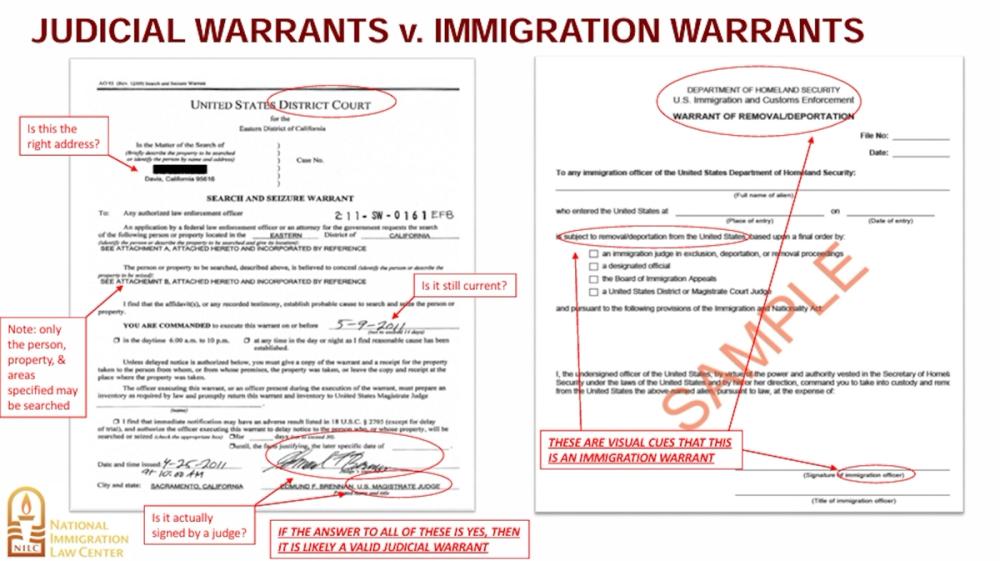
Note the heading, the address, the individual identified, the date, and if the document is signed by a judge.
Related Content

Know Your Rights (Saline Community Panel)
Know Your Rights: An Educational Community Panel on ICE and Immigration